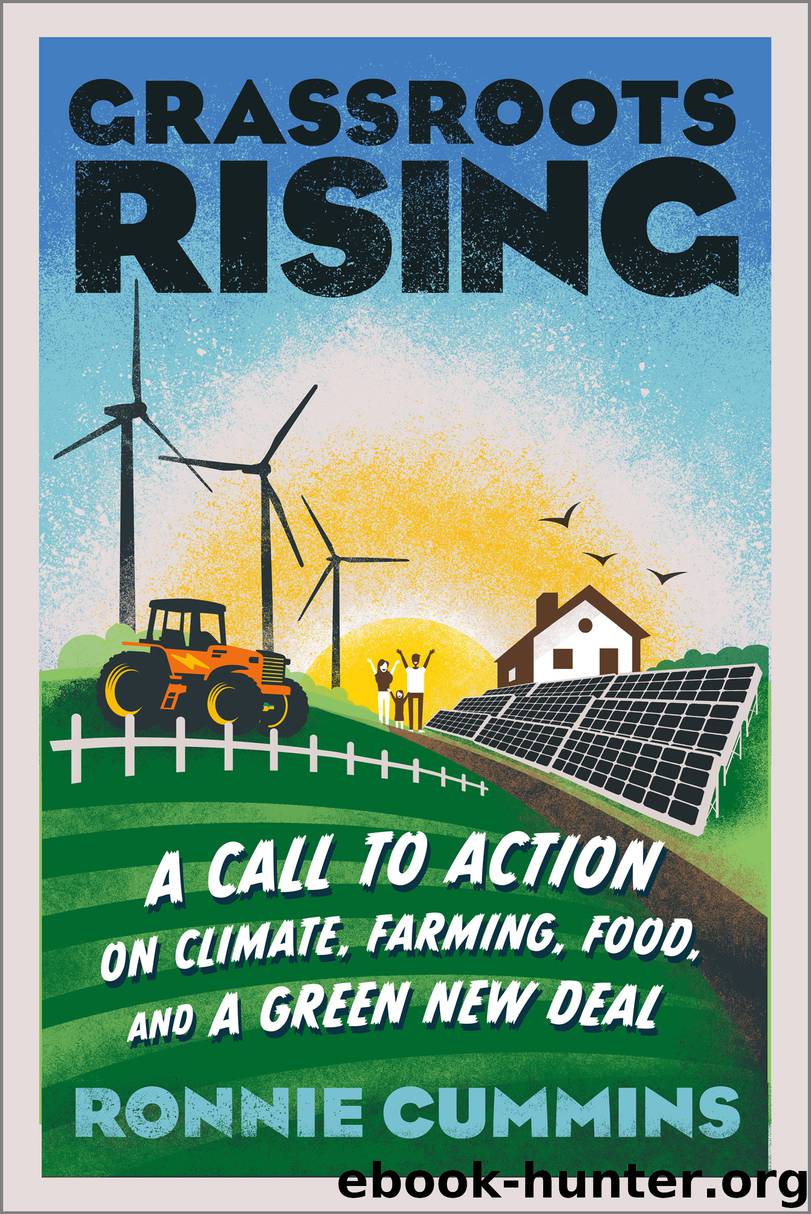
Grassroots Rising by Ronnie Cummins
Author:Ronnie Cummins
Language: eng
Format: epub
Publisher: Chelsea Green Publishing
6
Public and Private Investment
< regeneration driver four >
Ultimately, we need to transform finance and shift the flow of investment capital to perpetuate a Regenerative Economy that serves humanity and is a steward of Earth’s ecosystems.
JOHN FULLERTON and HUNTER LOVINS, “Creating a Regenerative Economy to Transform Global Finance into a Force for Good”
Impact investments in agriculture represent a huge opportunity to implement deep changes in farming methods and adopt new ways of producing food that help mitigate climate change through lower greenhouse gases emissions, help respect the environment and biodiversity, enhance food security and climate change resilience and promote social equity.
VALORAL ADVISORS, “Impact Investing in the Global Agriculture and Food Investment Space”
As outlined in the previous chapter, we will need to bring about massive political change in order to fund and implement a multitrillion-dollar Green New Deal (GND). This GND will drastically increase public investment in renewable energy, regenerative land use, job creation, social services, public education, and infrastructure development, resolving our climate emergency and addressing our longstanding social, public health, and economic crises. But in addition to these huge political and public investment changes, we also need to transform private commerce and investment practices.
We need a massive shift in local, regional, and global investments away from degenerative energy, food, farming, and land use practices, as exemplified by “blue chip” investments in the stocks of the Fortune 500 corporations, to renewable and regenerative practices. Given the enormity of our world-changing endeavor, we’re not going to be able to adequately fund a rapid transition to 100 percent renewable energy and regenerative practices over the next twenty-five years with just government bonds, loans, subsidies, and investments, nor with nonprofit grants, grassroots crowd-funding, and our own meager revenue or savings, no matter how hard we try. To move toward a new regenerative system will require not just government support, but massive amounts of private investment capital as well. So-called progressive foundations—for example, the Kellogg Foundation, Rockefeller Foundation, Pew Charitable Trusts, and Ford Foundation—that dole out several hundred million dollars annually in grants to nonprofit energy, food, farming, and land conservation organizations and projects, ostensibly to promote sustainability or other public interest goals, actually are donating only about 5 to 7 percent of their assets or endowments to tax-deductible organizations. The other 90-plus percent of their money, hundreds of billions of dollars, remains locked up in conventional stocks, bonds, and mutual funds, propping up “business as usual” for the Fortune 500, while earning, for their collaboration, 3 to 5 percent or more, on average, in interest every year.1
The average financial return on these foundations’ destructive investments in fossil fuels and industrial food and agriculture is actually less than what they could earn, on average, by investing in local organic and regenerative farms and small businesses—enterprises that generate far more jobs and economic benefits for everyday citizens, instead of simply fattening the coffers of the wealthy. As Michael Shuman puts it in his book Local Dollars, Local Sense, conventional investors are “overinvesting in Wall Street and underinvesting in Main Street.
Download
This site does not store any files on its server. We only index and link to content provided by other sites. Please contact the content providers to delete copyright contents if any and email us, we'll remove relevant links or contents immediately.
Tools of Titans by Timothy Ferriss(8490)
Change Your Questions, Change Your Life by Marilee Adams(7847)
Deep Work by Cal Newport(7160)
Playing to Win_ How Strategy Really Works by A.G. Lafley & Roger L. Martin(6499)
Man-made Catastrophes and Risk Information Concealment by Dmitry Chernov & Didier Sornette(6138)
Digital Minimalism by Cal Newport;(5835)
Big Magic: Creative Living Beyond Fear by Elizabeth Gilbert(5831)
Ego Is the Enemy by Ryan Holiday(5527)
The Slight Edge by Jeff Olson(5463)
The Laws of Human Nature by Robert Greene(5324)
The Motivation Myth by Jeff Haden(5242)
Stone's Rules by Roger Stone(5129)
Tuesdays with Morrie by Mitch Albom(4851)
Eat That Frog! by Brian Tracy(4596)
Rising Strong by Brene Brown(4512)
Skin in the Game by Nassim Nicholas Taleb(4306)
The Money Culture by Michael Lewis(4266)
Bullshit Jobs by David Graeber(4249)
Skin in the Game: Hidden Asymmetries in Daily Life by Nassim Nicholas Taleb(4051)
